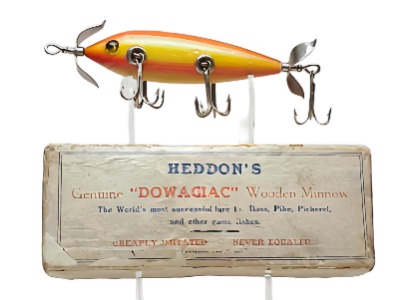
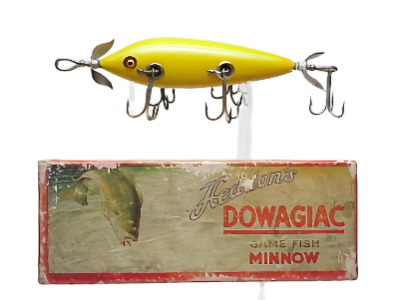
|
As the dollar value of antique
lures rise at a head spinning rate, the necessity of accurate
grading becomes more and more critical. When it was just a bunch
of good old boys trading lures they loved, the fine points of
grading didn't matter too much. Today we are talking about $500 or
$1,500 lures instead of $5 lures, so the matter of grading is
extremely important.
With higher prices our collections
are going to be smaller. Each addition to a collection is a major
financial decision where you can't afford to make a mistake.
Fortunately, the advent of the Internet and the ability to send
photos across the country in a matter of seconds has helped solve
many grading problems because as they say, a picture is worth a
thousand words.
If you want to get into a fired up
argument, put three lure collectors in a circle, throw a lure in the
middle and ask for a grade. More than likely you will get three
different opinions. For this article, we'll dispense with the usual
photos or list showing NFLCC grades and limit the discussion to
factors which effect grading rather than making statements about
absolutes.
VISUAL
VALUES:
One of the hottest controversies in
any type of collecting, be it coins, guns, or lures, is
communicating grading values. The collectors who have seen
everything will grade totally different than the novice who knows
nothing. Perhaps the most dangerous person is the one who has only
seen lures at the flea market and tries to communicate the condition
of a lure when all he or she has ever seen is a lure in very good
condition at best. What you know about grading is relative to
what you have seen. Grading is visual.
How are you going to get through to
"an average condition collector" what a pristine condition lure
should look like... much less discuss the fine points of plus and
minus grades?The representations on eBay.com by non-collectors, and
not a few NFLCC members, are typical of this problem. Hopefully we
can cover a few topics here to help us better communicate.
When we start getting picky about
lure condition, a 10X handheld glass magnifying lens is handy for
examining the paint surface, hardware, and searching for crazing .
I frequently look at lures under a 30X binocular dissecting
microscope just to get an idea of how the surfaces look at high
magnification. This is getting kind of anal about the topic, but if
you are looking for fakes, it is an excellent way to detect
"workmanship".
See the article on
Grading Lures
for photos and additional information
DEFINITIONS AND TERMS FOR LURES:
The following are commonly used
terms and illustrations of defects which alter the grade of a lure.
They are the types of defects that can change a grade by a plus or
minus, and understandably the price. No one defect will set the
grade, but these are the types of problems which can be used to
differentiate between Excellent and Excellent minus or between
Excellent minus and Very Good.
Plus and minus are in the eye of
the beholder, but they are the variations which can cause large
swings in price. Most collectors will pay a lot more for an
excellent plus lure than for an excellent minus. So, let's look at
the factors that determine plus or minus and often can change a
whole grade level:
-
Pointers:
Marks made by the hook points as they swung around and contacted
the paint or varnish at a single point. Basically it's a tiny
puncture hole in the paint or varnish. Commonly referred to as a
'pointer'. One or two are no big deal, but when the surface
looks like the face of the moon it's a whole different matter.
When describing pointers, it is best to refer to the exact
number, depth and size. If the hook penetrated into the wood
and created a crater, then that is a worse situation than one
which just marks the varnish and doesn't touch the paint.
-
Flakes:
Usually in reference to varnish (not people) which are the
result of the varnish sticking to something and being pulled off
the paint, or an actual varnish chip down to, but not including
the paint color. Varnish flakes are highly subjective, but in a
heavily varnished lure like a Heddon, large areas of varnish
flakes can and do seriously detract. If you are talking about
paint flakes, then the matter is serious since value decreases
drastically with any paint loss. Heddon series 00 lures are
notorious for flaked varnish due to all the sharp edges which
stuck to the box or anything else. Flaking can usually be
expressed in terms such as minor, heavy, light, or minimal along
with the location. Examination of the surface with a 10X lens
should show sharp edges of the flakes as opposed to a smooth
rounded edge which may be caused by buffing or chemical
treatment of the surface.
-
Crazing:
Also known as 'checking', these are age induced minor separation
fractures of the paint or varnish. Usually there is a fine
quilted pattern to the cracks which look like brick work under a
10X magnifying lens. This is not to be confused with deep splits
of the paint which are better termed cracks. In a heavily
varnished lure like those produced by Heddon, Pflueger, or South
Bend, I personally find it comforting to see crazing because it
is indicative of age and quality. It is also extremely
difficult to fake subsurface crazing. Terms used to describe
crazing would be lightly crazed, heavily crazed, finely crazed,
checking, or only obvious with a 10X lens.
-
Hook drag:
a semi-circular scratch made by a hook into the paint or
varnish. If it is into the paint, then it's serious and
greatly detracts from the value. If only into the varnish and
very, very light, then it's a personal call, but a hook drag
takes any lure out of the excellent range. If you see a
semi-circular mark on the surface, then you are talking hook
drag and it needs to be described.
-
Cracks:
Separation of the
paint or varnish down to the wood and not normal. Cracks are a
source of water getting to the wood resulting in swelling which
causes the paint to flake or pop off in large sections. In some
cases, cracks in the paint are like crazing where it is a
feature of rare, early lures which is esthetically disturbing,
but can verify the origins of the paint on an otherwise
excellent condition lure. Repaints typically would not have
cracks. Cracked eyes are something that should be noted, but
have influence on condition in the plus and minus department.
-
Chip:
Paint loss in
varying sizes, but usually down to the wood. If you are thinking
you have to express the amount of paint loss as a percentage,
then forget anything above Very Good for condition. If there is
enough paint loss to worry about expressing it as a percentage,
then you have something in the "fished" or used department.
Paint chips greatly effect the grade of any lure, be it ancient
or just old. One may accept a paint chip, but be sure to
carefully note its existence when describing a lure with paint.
-
Shiny:
(a.k.a. lipstick shiny, slick, wet) A term used to describe the
slick, smooth, non-dull, quality of well preserved paint which
has not been subjected to chemicals or intense light. The
opposite of the shiny surface would be dull, dirty, and lifeless
paint as a result of exposure to chemicals, light, dirt, or use.
Degree in either direction determines plus or minus grade.
-
Beater:
a lure that is in less than Average condition. Not collectible,
but useful for parts. Many people who do repaints buy beaters
to strip and repaint. Some of which are passed as new lures.
-
Rub or scrape:
A rub is a smooth, shallow paint or varnish loss via rubbing,
not a chip, not a flake, but more than likely due to rubbing
against a hard object like a box top or being deeply cleaned.
Depending on the extent, a negative factor, but not a big deal
if a light, small area. Scrapes are typically deeper, represent
greater damage, and often involve cutting the paint.
-
Otherwise Excellent:
A term used to describe a lure with one small defect which may
or may not effect the asking price of a lure. Typically a
single minor pointer, flake, chip, or paint off the belly
weight, but not indicative of the whole lure which is "otherwise
excellent".
-
Touch-up:
Typically adding new varnish, gill marks, or an attempt to match
the existing antique paint with new paint to hide a defect. A
no-no and automatically removes the lure from being a
collectible. Touch-up's are easily detectable with a black
light which will show the difference in paint age and type.
Contrary to the official NFLCC stand on this issue, I personally
don't want a touched up lure in my collection at today's prices.
-
About Very Good:
A term used to avoid listing all the problems on a lure or box.
-
Repaint: a lure body
that has been repainted by an arts and crafts person. Not
something that should be in the tackle collecting scene. If
properly marked, a curiosity fit for shadow box displays used by
interior decorators and walls in sports bars. Is that clear?
-
Hangs well:
The ultimate
euphemism for "It's only good on one side". Otherwise see
beater.
-
Whizzed:
A term used by coin dealers to describe extensive polishing of a
surface. Some people delight in rubbing a lure with cleaner
until it is without gill marks or varnish in an attempt to
upgrade the value. What they accomplish is destruction of the
lure and it's value. Cleaning is one thing, polishing to remove
the varnish is another. If you remove the varnish on a lure,
you have greatly decreased the value and there is no way it can
be considered being anything more than Average in grade.
-
Worm burn:
The result of a
plastic worm being left against lure paint for an extended time.
Typically the paint melts and leaves a messy goo where the worm
was in contact. Causes a burn-like mark similar to what a
cigarette does to Formica or a laminated furniture surface.
Typically earns the lure a 'hangs well' grade, but eliminates it
from anything above used, or beater condition.
-
Stupid:
What some of us get when we start rationalizing how valuable a
ratty old lure is because of its age.
DEFINITIONS AND TERMS FOR BOXES
Not much has been
written about the grading of boxes, either cardboard or wood. I'm
not going to try to get too involved in discussing these treasures,
but it is necessary to be accurate in describing any problems with a
box. A collector, Marie Unger, brought this need to my attention,
so I offer her grade descriptions as a part of this discussion.
See the article on
Grading Lure
Boxes for photos and additional
information
When discussing lure boxes:
-
Water marked:
If you note irregular lines or unusual color changes in the
surfaces of a box which look like they are not a part of the
design, then you are most likely looking at water stains. The
change is obviously due to the box coming in contact with water
or other solvents which would cause the dye in the box paper to
run, fade, or bleed. It is a question of extent of damage that
is important. If the dark red dye on a Heddon box has bled into
the large white background areas, then that is major. If, on
the other hand, it's just a light dye line across the white,
then it's most likely no big deal, but should be noted.
-
Stiff and hard vs. mushy and wavy:
New cardboard boxes are not smushed or wavy on the sides. The
corners are square, the sides are straight and hard. If a box
has been wet, then the sides get wavy, the paper gets mushy and
frequently lifts away from the underlying cardboard. Typically
box collectors will talk about new condition boxes being "hard"
as in stiff and straight.
-
Unmarked vs. marked:
When boxes were shipped from the factory,
they were typically marked with a number or description for the
lure they contained. Unmarked boxes may be faded due to light
exposure. The inked number may be diluted due to having been
wet, or in some cases simply rubbed off. The value of a lure
will be greatly enhanced when in the correctly marked box vs. an
unmarked box. If the box is unmarked, then it is "just a box",
not "the box".
-
Edge wear:
Typically the edges of darker boxes, like maroon or black boxes,
will show edge wear and the underlying lighter color of the
cardboard is exposed. The edge wear can be described as light,
heavy, or not detracting, but the extent should be described.
If the paper is peeling back and the cardboard is exposed, that
should be noted.
-
Faded lettering:
The most typical problem with wood boxes is the fading of the
ink used to imprint the top or sides of the box. Typically
someone will try to clean a wood box and literally rub off the
print. Fading on paper labels is common due to sunlight
damage. If you can't read the writing... note it.
-
Crisp photos or graphics:
Typically, offset photography used on some labels will fade with
time and exposure to light. The relative crispness of the
photos or drawing should be described.
-
Insect damage:
Because boxes and labels are paper, they are frequently damaged
by insects. The chewed edges are obvious and should be noted.
-
Dirt, mildew, and oil saturated:
Often boxes are just plain dirty and dark looking. Oil can
saturate a wood box, render it unrestorable, and leave a solid
cardboard box dark and dingy. Many boxes are just plain dirty
from years of dust and mildew. Mildew will have a dark spotted
look rather than the even gray look of dirt.
-
Markings:
It is not unusual for a price to be handwritten on a box. If
so, all the better to know what it cost in 1908. On the other
hand if it says "To Bob with love", or "Fred's favorite frog"
then it detracts and should be noted in the description.
-
Partial Label:
Often parts of a label will be missing. The percentage and what
exactly is missing should be noted. If the name of the company
is gone or the name of the lure, that will be significant and
should be described thoroughly.
-
Joints:
Cardboard boxes are "taped" or overlapped with paper at the
corners or joints. If the integrity of the corners is lost and
the paper splits, the side panels are separated. This greatly
detracts from the value of the box. Tape should never ever be
used to repair a box. Repairing boxes or paper is an art that
should not be taken lightly as a valuable piece can be easily
ruined. On wood boxes, the finger joints or rails may be
broken. If so, that should be noted and reported in the
description.
BOX GRADES:
-
Mint:
Box should look like it came off the shelf. Crisp, no dirt, corners
sharp, and no wear. All lettering crisp and clear. Price tags or
written price should not detract. Structure of the box must be
stiff and unwarped. No water marks or sunlight fading damage.
-
Excellent: Box
will have very minor wear to the corners and some wear around the
edges. All wording and lettering should be clear. No rips or tears.
Price tags or written price should not detract. Structure of the
box must be stiff and unwarped. No water marks or sunlight
damage. Wood boxes should have correct tops that fit properly and
no fading of the printing. The wood should be completely clean and
no oil or dirt in the wood as well as no evidence of cleaning.
-
Very Good: Box will have wear to corners and wear around
edges. Box may have light soiling or light water marks. Box may have
very minor tears (e.g., paper label applied that is starting to peel
up) or very small dents. Some of the lettering may be slightly
worn. Structure is still there, box will be square at corners and
along panels. No mushiness to the side or tops. If it's a wood
box, the joints may be sprung or the top not working normally.
-
Good:
Box will have dirt, stains or water marks. Probably looks "dingy"
overall. Lettering will be worn, but you should be able to read part
of it. Box may have tears or repairs with tape. Structure may be
distorted and joints of the box may be split. Sides of box are not
straight or stiff.
-
Poor:
Barely readable lettering. Stains, soiling, with tears or parts of
the box missing (end flap, etc.). Structure is gone, box not stiff
or squared. Sides, bottom or top are mushy due to water damage.
Ladies and gentlemen,
the bell has rung. Please come out swinging and let's have a clean
fight. This round will end when the last collector leaves the room. |